selective catalytic reduction system
Where the limits on NOx emissions cannot be met by combustion
control, flue gas treatment must be installed. The dominant
method in use is selective catalytic reduction (SCR). Plants
are in operation where the NOx concentration is reduced by over
80~90%.
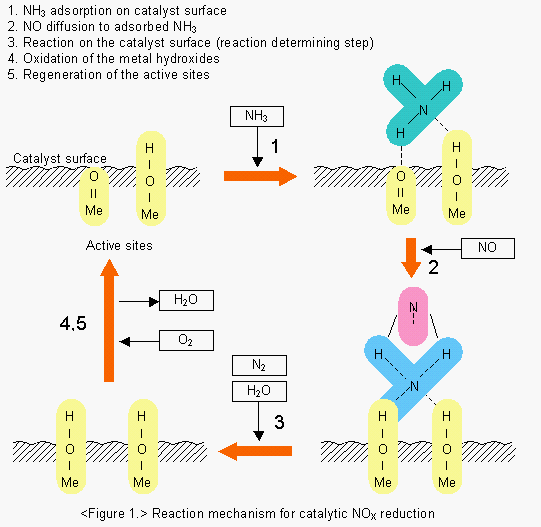
In the selective catalytic reduction method the NOx concentration
in the flue gas is reduced through injection of ammonia in the
presence of a catalyst. The role of the catalyst and the reaction
mechanism is described in Figure 1 for a metallic based catalyst.
|
| The reaction products are nitrogen and water. The reaction
is selective which means that oxidation of ammonia and sulfur
dioxide should not occur.
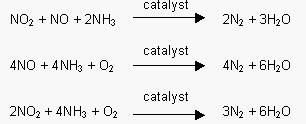
The most common reactions are;
|
The temperature at the catalyst is very important for the reactions.
The optimum temperature is usually between 300℃ and 400℃. The
possible temperature is between 180℃ and 450℃.
Different types of catalyst can be used. The activity of
the catalyst is also important for the level of NOx reduction
as well as for other reactions such as oxidation of sulfur
dioxide. A more active catalyst normally means a less selective
catalyst. The activity of the catalyst is mainly dependent
on catalyst composition and flue gas temperature.
The efficiency of NOx reduction is dependent upon several
injection, oxygen concentration, and catalyst properties such
as space velocity (SV), and active area (see Table 1 for definitions). |
Table 1 Definitions and formulae for SCR
Definitions
|
Symbols |
Formulae
|
1-Chamber RTO/RCO |
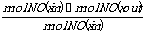
NOx(NO+NO2)Reduction
efficiency
|
η |
|
|
| Stoichiometic
ratio |
SR |

|
|
Catalyst
Volume
|
Vcat |
|
m3 |
Catalyst
area, geometrical
surface area
|
Acat |
|
m3 |
Flue
gas flow
|
Vfg |
|
m3/hr |
Space
velocity
|
SV |

|
hr-1 |
| Surface
area loading |
AV
|

|
m/hr |
| Catalyst
activity |
K
|

|
m/hr |
* standard basis, wet gas |
An increase in ammonia injection leads to increased NOx reduction,
but the amount of ammonia which reacts with the nitrogen oxides
depends on the activity of the catalyst. The unreacted ammonia
leaving the stack is called ammonia slip.
The main characteristics of the catalyst include its volume,
area, space velocity and selectivity.
The space velocity is considered to be a crucial design parameter
in an SCR reactor. It is a measure of the residence time of
the flue gas mixture (at standard temperature and pressure)
within the volume of the catalyst. Calculation of the required
space velocity for a given application takes the following
factors into account; efficiency, temperature, permissible
ammonia slip, flue gas analysis and dust analysis.
The selectivity of the catalyst defines the extent to which
the desired reactions occur. A decrease in selectivity allows
unwanted reactions such as the oxidation of sulfur dioxide
to sulfur trioxide depends mainly on the properties of the
catalyst and the flue gas temperature. The actual amount of
sulfur trioxide produced depends also on the original concentration
of sulfur dioxide in the flue gas. More active catalysts with
a lower specific volume lead to a higher rate of sulfur dioxide
oxidation. The reaction, however, is temperature dependent.
Most SCR plants have a guaranteed value for the maximum permitted
sulfur dioxide oxidation at a specific flue gas temperature. |
| Type |
Activity
|
Field of
application
|
Type of
fuel at high dust |
A
|
high |
clean gas |
gas |
| B |
average |
clean gas |
oil |
| C |
low |
raw gas |
coal |
|
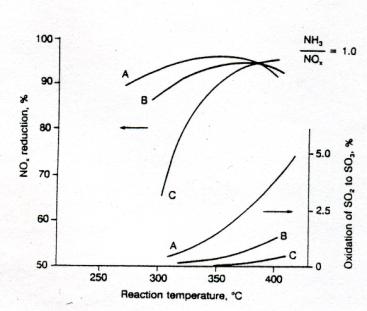
Figure 2 NOx reduction and oxidation
of sulfur dioxide
as a function of reaction temperature for different types
of catalysts (Huls, 1986) |
|
|
| The unreacted ammonia will react with sulfur trioxide in
the presence of water. The result depends on the concentration
of ammonia and sulfur trioxide and flue gas temperature. The
unwanted product is ammonium bisulfate (NH4HSO4),
a sticky compound which can cause corrosion, fouling and blocking
of equipment down stream in the flue gas flow. Figure 2 shows
the influence of temperature, concentration of ammonia and sulfur
trioxide in flue gases on the formation of ammonia sulfate and
ammonium bisulfate. With a given combination of ammonia and
sulfur trioxide concentration, the temperature line gives the
temperature below which the product in that field of the diagram
is produced. |