
R.T.O
Rotary 1-Can RTO
Process
"The most important function of the combustion device in OXidation chamber is to enable Voc substance to achieve optimal Destruction efficiency from combustion, along with other important factors as high heat recovery efficiency for minimized fuel consumption in operation. The advantageous combustion device type is 2-Chamber type which provides 95% of Destruction efficiency and over 95% heat recovery efficiency. However, due to the necessity of simultaneous switching at damper in converting the flow of in-flowed gas, a certain portion of incombusted gases are leaked through the outlet at that point and subsequently result in only 95% of destruction efficiency but not 99.99%."
"As an improvement to this current problem, 3-Chamber type combustion device which is added with 1 more heat media chamber is capable of achieving over 99.99% of destruction effect. However, the as this improved type requires higher cost, it is desirable consider such factors as inflow Conceatration of applicable gas, the object value of exhaust conceatration and facility investment cost when selecting the appropriate type of combustion device. We have developed Rotary 1-Can RTO and commercialized 2 years ago which compensates defects of 3-Chamber RTO by providing high destruction efficiency of over 99%, less facility investment cost and easy operation and maintenance."
|
 |

Device description
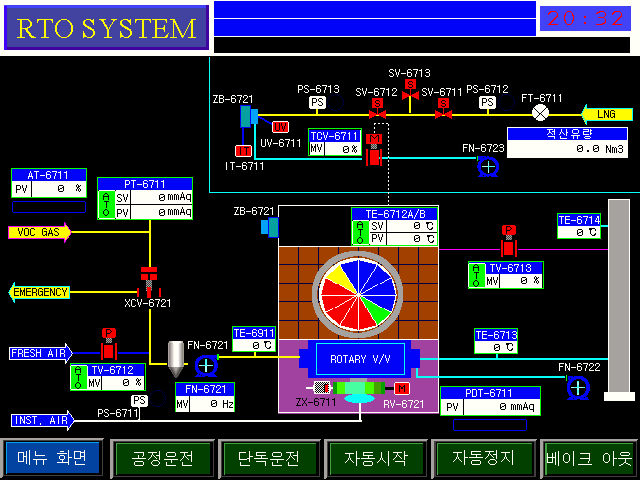
"Our Rotary 1-Can RTO is a vertical and round type structure where damper, regeneration chamber and combustion chamber is placed in-line. It features compact device size and high VOC destruction efficiency of over 99%. The rotation type damper is constructed with a round stator with 12 sections, a rotator that converts gas flow by 30 degrees, a driver that converts the direction of rotator to axial, and a pressure device that adheres the rotator and the stator, and is equipped with round regeneration chamber that has 12 chambers in upper part of round type damper. The air flow is converted by each regeneration chamber when rotating driving device rotates by 30 degree, and the supply VOC regenerates the discharging regeneration chamber while being discharge through discharging regeneration chamber (5 chambers) after being heated through supplying regeneration chamber (5 chambers) and incinerated at combustion chamber. Further, 1 combustion chamber and 1 purge chamber are provided. Purge chamber is made to re-combust the uncombusted gas remaining in combustion chamber by purging at the time of 30-degree rotation of rotating type damper. "
"Therefore, the system is a high efficient combustion device of which destruction efficiency is enhanced up to 99%. The combustion temperature is maintained at 750 ~ 900°C for a certain period of residence time to oxidize VOC gas. Heat media is adapted with Honeycomb type ceramic materials in order to maximize the regeneration effect with minimum pressure loss. The damper that converts gas flow maintains prompt and accurate switching as well as stability, while its driving system is adapted with RATCHET GEAR type in order to maximize the oxidation and heat recovery efficiency by converting on a periodic and appropriate cycle. It is highly economic to use the discharge gas from combustion as a purge gas with less heat loss."
- By adapting ratchet gear with 12 phases, gas inflow and outflow are accurately proportioned and over 99% of destruction efficiency is guaranteed.
- High heat recovery. (over 95%)
- Bake-Out function to prevent lower bed pollution due to adhesive poisonous gas.
- Simple crank type rotating damper prevents device failure, while providing accurate transfer between chambers and no gas leakage as well as easy maintenance.
- Rotating damper’s continuous operation provides even flow of combustion gas and even concentration of discharged gas while preventing pulsation as 2-Chamber type.
- Less dead space than 3 Chamber Type requires lower fuel consumption.(3 Chamber ; approximately 30%, 1 CAN ; approximately 17%)
- The surface temperature of rotating damper is higher than that of entry gas, which prevents surface condensation and corrosion.
- Low pressure loss by adapting Honeycomb type heat media and less installation area with compact device size.
- Highly economic by recycling the discharge gas as purging gas.
Applicable field of our Rotary 1-Can RTO
"All business places treating and manufacturing VOCs including Film manufacturing, Petrochemical, Painting, Painting booth, Automobile, Semiconductor”
2-Bed RTO
Technology overview
Our 2-Chamber RTO features such benefits as simple combustion chamber structure, compact device size, easy maintenance and low initial investment cost. However, due to the inherent disadvantage of 2-Can type, it is hard to maintain the destruction efficiency at over 95% because the incombusted gas residue at damper and combustion chamber are discharged at the point of damper switching as well as pulsation at RTO shearing. The combustion temperature in combustion chamber is maintained at 750 ~ 900C for an appropriate RESIDENCE TIME in order to completely thermal resolute the gas inflow. Heat media is adapted with Saddle or HoneyComb type ceramic materials to realize the maximum regeneration efficiency with the least device size.
The damper that converts gas flow maintains prompt and accurate switching as well as stability in order to maximize the heat recovery efficiency. "A and D dampers are opened with B, C still closed where the gas inflow from A is discharged through D after processing. Few minutes after this, A and D are closed while B and C are opened by the damper switch where the gas inflow from C is discharge through B after processing. This operation of damper induces repetitive regenerations and discharges to finally generate heat exchange. Rotary 1-Can RCO also operates with identical process."

Features of our 2-Chanmber RTO
Inexpensive initial investment.
Simple structure and easy maintenance and repair.
High reliable through prompt and accurate damper switching.
Heat recovery efficient of over 95% by adapting heat media of Ceramic Saddle or HoneyComb Type, and little requirement in installation area on site.
Appropriate for devices requiring over 95% of VOC Destruction Efficiency.
Features Bake-Out function that prevents pollution in lower regeneration layer by adhesive poisonous gas.
3-Bed RTO
Device description
Device description "The disadvantage of 2 Chamber TYPE such as the incombusted gas being discharged at the point of damper switching is compensated with this device.
1 chamber that prohibits any gas pass through is added in order to combust the incombusted gas residue at duct passage and regeneration chamber by pushing it with purge gas before the gas flows in. Subsequently, the combustion efficiency is enhanced up to over 99.9%. The combustion temperature is maintained at 750 ~ 900C for an appropriate Residence Time in order to combust the VOC gas.
Heat media is adapted with Saddle and HoneyComb type ceramic materials to maximize the regeneration efficiency with minimum device size. The damper that converts gas flow maintains prompt and accurate switching as well as stability in order to maximize the heat recovery efficiency. It is highly economic to use the discharge gas from combustion as a purge gas with less heat loss than using external air.”
Features of our 3-Chamber RTO
Advantageous in gas adaptation with high inflow density by over 99.9% of resolution efficiency.
High reliable through prompt and accurate damper switching.
Features over 99.9% of heat recovery however requires more installation area than 2 chamber type due to larger size.
Highly economic with recyclable discharge gas as for purging.
Features Bake-Out function that prevents pollution in lower regeneration layer by adhesive poisonous gas.
