
1. Recoverability
If the recovered material can be recycled into the process, used as boiler fuel, used as a cleaning solvent for the equipment, or otherwise valuable as a commodity for other uses, the recovery method should of course be taken into account rather than the final treatment . Examples of the recovery method include adsorption-desorption, cooling condensation, and distillation.
2. Emission uniformity
Whether the air volume and concentration are constant, varying or periodic when the exhaust containing VOCs is released should be carefully considered when selecting the treatment method.
As in the batch process, when the change in the air volume and the concentration is severe, the processing apparatus wears up, the heat recovery efficiency is lowered, and the destruction and removal efficiency may also be lowered.
As in the batch process, when the change in the air volume and the concentration is severe, the processing apparatus wears up, the heat recovery efficiency is lowered, and the destruction and removal efficiency may also be lowered.
3. Complexity of VOC components
If several components are mixed, even if it is first recovered, a re-separation device is needed and there is a limit to the selection of the treatment method. When designing the treatment method, the DRE (destruction efficiency) should be based on the substance that is the most difficult to destroy among the VOC components.
4. LEL and UEL
In principle, all treatments should be designed to be diluted to less than 25% of the LEL. It should also be considered sufficiently that the concentration can not exceed the LEL at any moment in the structure of the duct, the initial start up, shutdown and failure of the treatment system. In some processes, emissions exceeding the UEL are emitted, in which case recovery by cooling condensation is mainly used. However, since the concentration may fall between UEL and LEL as the recovery proceeds, it may be possible to explode, so dilute it with nitrogen or carbon dioxide instead of air.
5. Discharge temperature
Cooling condensation or adsorption methods are not only economical to cool if the temperature is above 40 ° C, but also can not expect normal adsorption power. However, the higher the temperature of the exhaust gas, the more economical the incineration method is because the auxiliary fuel consumption is reduced. Biological treatment methods should be maintained at a suitable temperature of 10 to 40 ° C for the microorganisms to be in operation, so that appropriate treatment efficiency can be expected.
6. Non-VOC material
It is very important to choose how to treat non-VOC components. If the dust is large, the surface of the adsorbent or the catalyst is clogged to lower the treatment efficiency, and when the heavy metals such as lead and sulfur are present, the catalyst can not be used. In incineration of the contained VOCs, post-treatment devices such as scrubbers are required, since the corresponding halogens are formed with acids, and the device must also be made of acid-resistant materials.
7. Installation site
In particular, if there are several sources, it is possible to install several small-scale treatment units depending on the presence of the installation site, or the sources may be connected to one large-scale treatment unit by one duct. In countries like Korea where the ground is cramped, methods that can be installed on the roof or on the roof may be the first choice.
8. Maintenance
The time, technical requirements and annual costs of maintenance are also important considerations. In the case of incineration, the consumption of auxiliary fuel and the frequency of replacement of refractories, the capacity and replacement timing of adsorbent in the adsorption tower, the consumption of chemicals in the scrubber, and the life and replacement cost of the catalyst when using the catalyst should be compared.
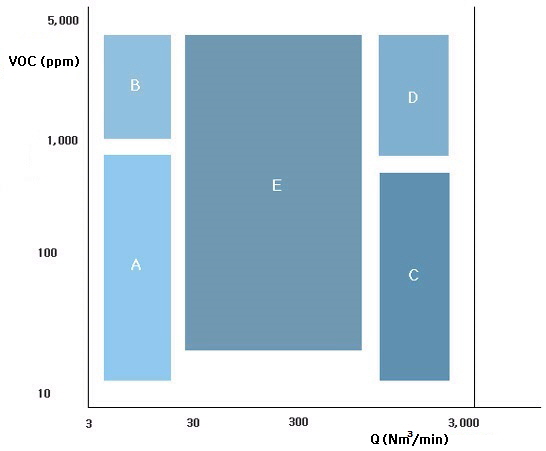
[Figure.1] Comparison chart of economical treatment method according to VOC concentration and flow rate
[Figure.1] is a comparison chart showing the approximate economic treatment method, considering only VOC concentration and treatment or recovery gas flow rate.
SECTOR A (low concentration low flow rate) |
Afterburner, Biofilter |
|---|---|
SECTOR B (high concentration low flow rate) |
Condensation is mainly used as an example of treating air containing solvent leaking from the storage tank of a petrochemical product or raw material, which is saturated in the tank, or leaking from a reactor of a pharmaceutical or chemical factory. |
SECTOR C (low concentration high flow rate) |
When it is necessary to treat a very low concentration of gas such as waste gas collected in a spray booth at a paint factory, use Zeolite Wheel or Carbon Fiber Wheel to concentrate the gas concentration 10 to 20 times, Or 1/20, followed by catalytic incineration or regenerative incineration (RTO). |
SECTOR D (high concentration high flow rate) |
When the amount of VOC is contained in a certain amount such as the waste gas collected in an oven or a painting booth of an automobile or a plastic painting factory, a method of using the heat amount of the VOC may be economical. Therefore, depending on the situation, VOC treatment can be done completely by reducing energy consumption by Recuperative Oxidation or Regenerative Oxidation. |
SECTOR E |
In this region, when the VOC concentration is less than 100 ppm, the biofilter is most economical from the viewpoint of low maintenance cost. However, if the catalyst can be used in some cases, the catalytic incineration can be an economical method. It is also economical to use an adsorption method in the case of an extremely low concentration. |
